Our method
First the swara sits right. Then the song comes easily.
Three things make our classes different: you learn one-on-one, you fix every swarasthana before the lessons begin, and you see the music drawn as lines while you sing it.
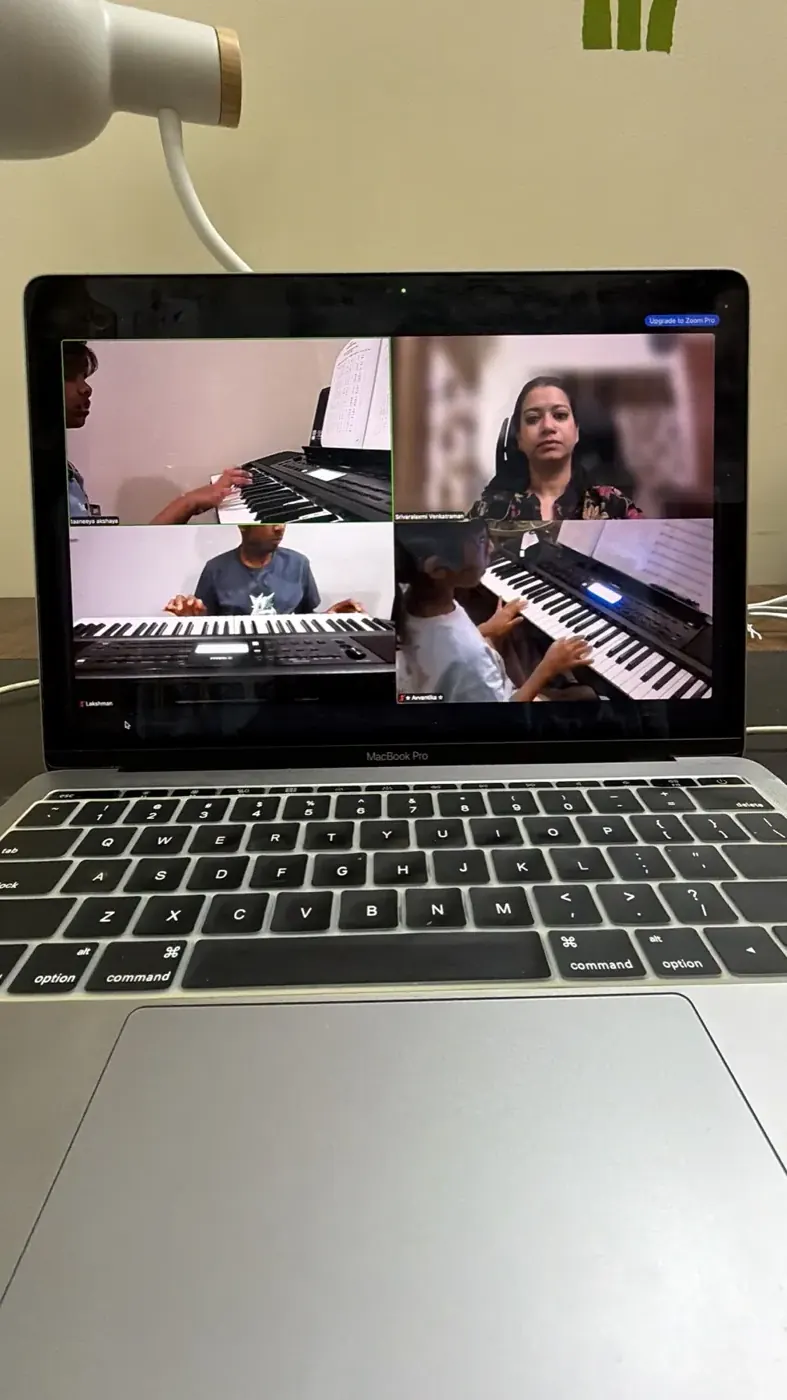
1 guru · 1 student
One-on-one teaching
A class that moves at your pace, not the batch’s
Vocal and keyboard students both learn one-on-one with their guru. The whole class is yours: your sruti, your doubts, your speed. If one swara needs twenty minutes today, it gets twenty minutes.
We run group classes too, and even there we teach the person and not the group. Each student is given what they are ready for, and nobody is hurried along or held back because of the others.
- Your own sruti, found in the first class
- Corrections on the spot, every time
- Lessons paced to your capacity
- Group classes that still look at each child
H · H · H
Hear. Hum. Hold.
Before sarali varisai, before anything, we set the swarasthanas right. The swaras are the alphabet of this music. If the alphabet is fixed properly, you sing in pitch from the very first lesson. It is a slow start, and it is the reason the foundation stays strong.
- 01 / 03
Hear
Your guru sings or plays one note. You only listen. No singing yet, just let the note settle in your ear.
Listen for a few seconds
- 02 / 03
Hum
Now hum softly and try to meet the note. Humming is gentle on the voice, so you can slide up or down until you feel the two sounds become one.
Match the pitch, quietly
- 03 / 03
Hold
Once the hum has matched, open it into the swara. Say “Sa” and stay on it, steady, without shaking or sliding.
Sustain for at least 8 seconds
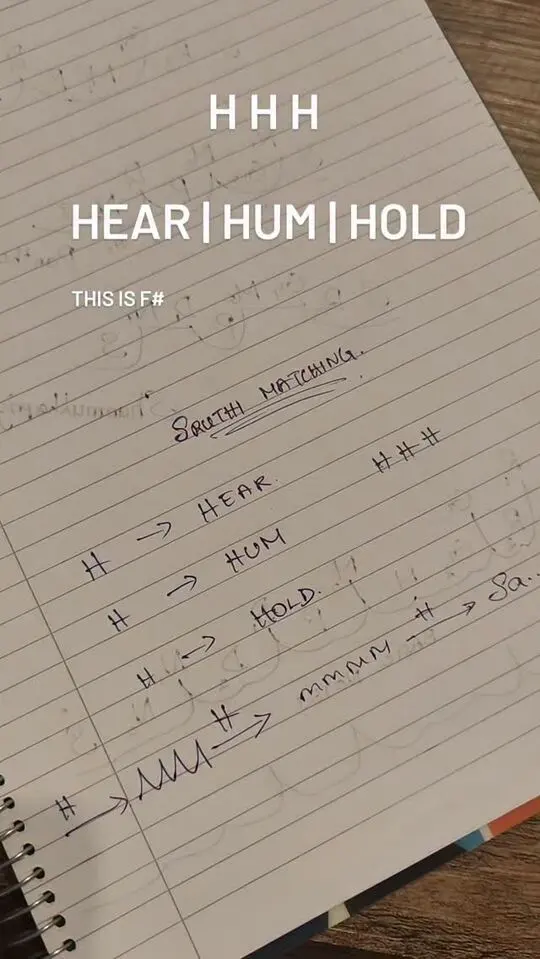 Watch the Hear, Hum, Hold reel on Instagram
We repeat this for all twelve swarasthanas. Only then do the foundation lessons begin.
Learning with lines
What if you could see “a little higher”?
Carnatic music has always been taught by ear. The guru sings, the student listens and tries to produce the same sound. It has worked this way for centuries, and it works beautifully when there is music at home and somebody to guide you between classes.
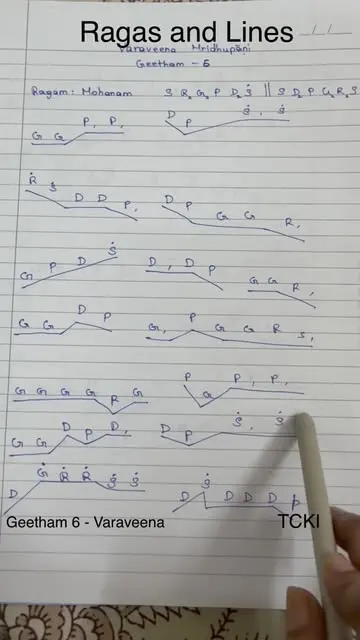
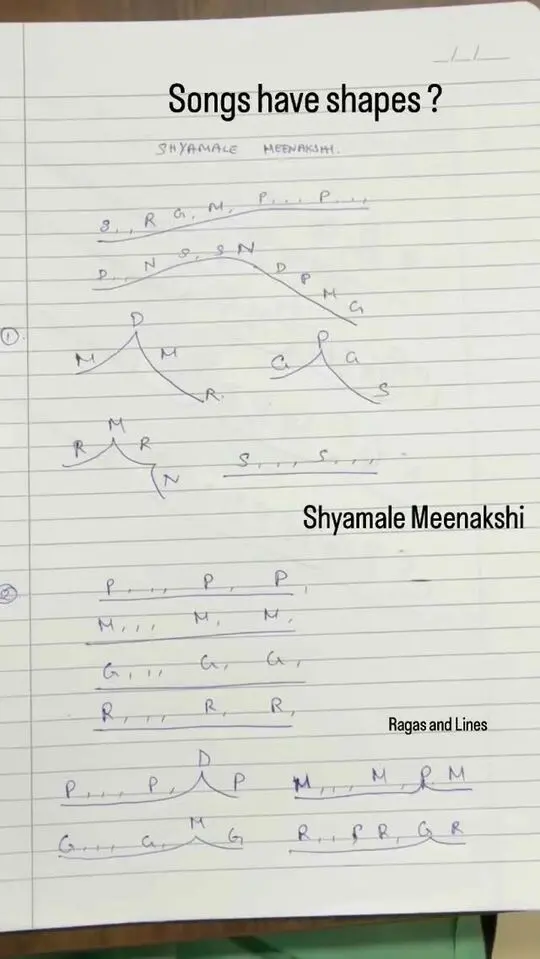
But what about everybody else? When your guru says “a little higher” or “a little lower”, where exactly is that? So we started drawing it. A simple line for each ragam, then for the sarali varisais, then for the geethams. The line rises where the tune rises and dips where it dips.
More than five lakh people have watched these drawings, and the response told us something. When your finger follows the line as you sing, the shape of the tune becomes clear in a way that words cannot manage. The ear still does the learning. The line just shows it where to go.
5,00,000+people have watched our line drawings
Questions
What people ask about the method
What is the Hear, Hum, Hold method?
It is how every student at Ragas and Lines begins. You hear one note from your guru, hum softly until your pitch matches it, then pronounce the swara and hold it steady for at least eight seconds. We do this for all twelve swarasthanas before the foundation lessons start.
Are the classes one-on-one or in groups?
Vocal and keyboard classes are taught one-on-one. We also run group classes, and in those each student is still taught according to their own capacity.
Why do you draw lines for ragas?
Carnatic music is taught by ear, which is hard when there is nobody at home to guide practice. A line that rises and falls with the tune lets a student see where each swara sits and how one phrase moves to the next. More than five lakh people have watched our line drawings.
Will the lines replace learning by ear?
No. The guru still sings and the student still listens and repeats. The line is only a guide for practice, so that the ear knows where it is going.
Your first class is free. Come and sing one Sa with us.
Thirty minutes, live and one-on-one. Your guru listens, finds your sruti and tells you honestly where to begin.